Research Dossier Target Company: A Complete Guide to Smarter Company Research

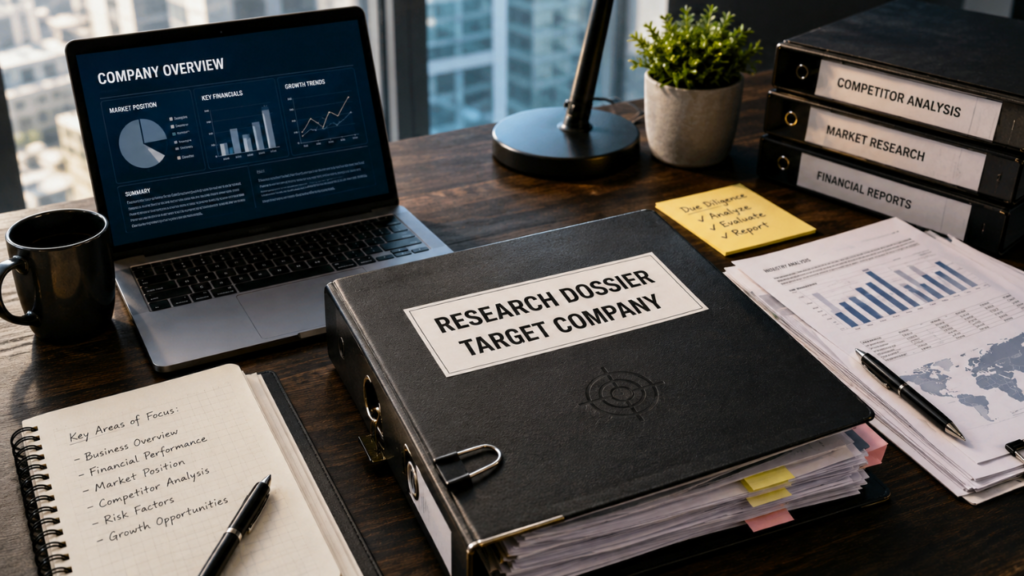
Researching a business before making an important decision can save time, money, and unnecessary risk. Whether you are preparing for a sales meeting, evaluating an investment opportunity, considering a partnership, studying a competitor, or applying for a job, scattered information is rarely enough.
This is where a research dossier target company becomes useful. It brings important information about one company into a structured document, making it easier to understand the organization, its market position, leadership, products, financial situation, competitors, opportunities, and potential risks.
A good dossier is more than a collection of facts. It connects reliable information with the specific decision you need to make. Instead of asking, “What can I find about this company?” the better question is, “What do I need to know about this company before I take the next step?”
This guide explains what a company research dossier is, what it should contain, how to build one, which sources to use, common mistakes to avoid, and how to turn research into useful business insights.
What Is a Research Dossier for a Target Company?
A research dossier target company is a structured research document focused on a particular business.
It collects relevant information from multiple sources and organizes that information into sections that are easy to review. Depending on the purpose, the dossier may cover company history, ownership, leadership, products, customers, financial information, competitors, market conditions, recent developments, risks, and opportunities.
The word “target” simply means the company being studied. It does not necessarily refer to Target Corporation, the American retailer.
The purpose of the research determines how detailed the dossier should be.
For example, an investor may concentrate heavily on financial performance, debt, growth prospects, and competitive risks. A salesperson may care more about business priorities, decision-makers, recent developments, and potential needs. A job candidate may focus on company culture, leadership, products, hiring activity, and future direction.
The strongest dossiers are therefore decision-focused rather than information-heavy.
Why Is Target Company Research Important?
Company websites often provide useful information, but they rarely tell the entire story.
A business website may explain its products and services, while financial reports reveal performance. Industry publications may provide market context, and credible news sources can reveal important developments. Combining these sources creates a much more complete picture.
A well-organized research dossier can help you:
- Understand how the company makes money
- Identify its primary products and services
- Evaluate its market position
- Understand leadership and organizational changes
- Identify competitors
- Discover potential opportunities
- Recognize important risks
- Prepare for meetings and interviews
- Improve sales and outreach strategies
- Support investment or partnership decisions
- Avoid relying on outdated assumptions
Research also helps separate what is known from what is assumed.
That distinction is especially important when a decision involves significant financial or strategic consequences.
What Should a Target Company Research Dossier Include?
There is no universal template that every company must follow. The contents should reflect the reason for conducting the research.
However, most useful dossiers contain several core sections.
| Dossier Section | What to Research | Why It Matters |
|---|---|---|
| Company Overview | History, location, industry, business model | Establishes basic context |
| Leadership | Executives, founders, key decision-makers | Shows who influences decisions |
| Products & Services | Main offerings, pricing, positioning | Explains how the company competes |
| Financials | Revenue, profit, funding, major trends | Helps assess business health |
| Market | Industry, customers, market trends | Provides external context |
| Competitors | Direct and indirect competitors | Shows competitive pressure |
| Recent Developments | Launches, hiring, acquisitions, expansions | Identifies current priorities |
| Risks | Financial, operational, legal, competitive risks | Helps reduce uncertainty |
| Opportunities | Growth areas and potential needs | Supports strategic planning |
| Sources | Links, reports, filings, dates | Makes research verifiable |
Not every dossier needs every category. The goal is to include information that can influence the decision.
Start With the Company’s Identity
Before analyzing a company, make sure you are researching the correct organization.
This sounds obvious, but businesses can have similar names, subsidiaries, parent companies, or different legal entities operating under related brands.
Begin by recording:
- Legal company name
- Trading or brand name
- Official website
- Headquarters
- Main operating locations
- Industry
- Year established
- Ownership structure
- Parent company, if applicable
- Stock ticker, if publicly traded
Identity verification prevents one of the most damaging research mistakes: accidentally combining information belonging to different companies.
For private companies, the official website, business registries, professional databases, and credible industry sources can help confirm basic information.
Research the Company’s Business Model
Knowing what a company sells is not the same as understanding how it operates.
A strong dossier should explain the company’s business model in simple language.
Ask questions such as:
- What products or services generate revenue?
- Who are the company’s primary customers?
- Is the business B2B, B2C, or both?
- Does it use subscriptions, one-time purchases, licensing, advertising, or another model?
- Which markets are most important?
- How does the company differentiate itself?
- What appears to be its main source of competitive advantage?
This section should be concise but meaningful.
For example, instead of writing that a company “provides technology solutions,” explain what those solutions do, who buys them, and why customers might choose the company over alternatives.
Examine Products and Services
Products and services reveal what a company considers important.
Start with the primary offerings, then look for recent launches, product updates, integrations, pricing changes, or expansion into new categories.
Pay attention to the language the company uses to describe its products. Marketing claims can be useful, but they should be treated as company positioning rather than independent proof.
Compare those claims with external evidence where possible.
For a sales or partnership dossier, this section can also help identify potential gaps.
For example, a company expanding rapidly may need additional technology, staffing, logistics, marketing support, or operational infrastructure. These possibilities should be treated as research hypotheses until supported by evidence.
Analyze Leadership and Key Decision-Makers
Leadership research is another important part of a company dossier.
Record relevant executives and their responsibilities, particularly when your research has a specific purpose.
Depending on the project, you might examine:
- Chief executive or managing director
- Founder or co-founders
- Chief financial officer
- Chief marketing officer
- Chief technology officer
- Head of sales
- Department leaders
- Board members
- Relevant recruiters or hiring managers
Do not collect personal information simply because it is available.
Focus on professional information that is relevant to your research objective.
Leadership changes can also be important signals. A newly appointed executive may indicate a shift in strategy, priorities, or organizational structure.
However, avoid automatically assuming why a leadership change occurred unless reliable evidence supports that conclusion.
Study Financial Information
Financial research can be one of the most valuable sections, especially for investors, acquisition teams, lenders, and strategic partners.
For public companies, useful information may include:
- Revenue
- Net income
- Operating income
- Cash flow
- Debt
- Assets
- Capital expenditure
- Earnings trends
- Guidance or outlook
Always attach a date or reporting period to financial figures.
A number without a date can easily become misleading because company performance changes over time.
Private companies may provide less financial information publicly. In those cases, clearly distinguish verified figures from estimates or third-party claims.
Do not present an estimated number as if it were an audited result.
Research the Market and Industry
A company does not operate in isolation.
Market research adds context to the company-specific information in your dossier.
Look at:
- Industry size
- Growth trends
- Customer behavior
- Major competitors
- Technology changes
- Regulatory developments
- Economic conditions
- Emerging opportunities
- Industry challenges
The objective is not to create a separate industry report.
Instead, explain how market conditions could affect the target company.
For example, if an industry is experiencing rapid technological change, investigate whether the company is adapting, investing, partnering, or falling behind.
This turns background research into useful analysis.
Identify Direct and Indirect Competitors
Competitive research helps explain where the company stands in its market.
Direct competitors generally offer similar products or services to a similar audience.
Indirect competitors may solve the same customer problem in a different way.
For each important competitor, consider:
- Product offering
- Target customers
- Pricing model
- Market positioning
- Strengths
- Weaknesses
- Recent developments
- Differentiation
Avoid simply creating a long competitor list.
A shorter list of meaningful competitors is usually more useful than dozens of names without analysis.
The goal is to understand competitive pressure and identify what makes the target company different.
Investigate Recent Company Developments
Recent developments can change the value of older research.
A company may have launched a new product, entered another market, acquired a business, changed leadership, announced layoffs, increased hiring, opened new locations, or formed an important partnership.
These events can reveal current priorities.
Useful signals may include:
- Executive appointments
- New product launches
- Acquisitions
- Funding announcements
- Partnerships
- Expansion plans
- Major hiring campaigns
- Restructuring
- Store or office openings
- New technology investments
- Regulatory developments
Always record when the event happened.
A research dossier should make it easy for a reader to distinguish current information from historical information.
Look for Risks and Warning Signs
A good dossier should not read like company advertising.
Balanced research includes potential weaknesses and risks.
Depending on the company, investigate:
- Declining revenue
- Heavy debt
- Customer concentration
- Strong competitive pressure
- Supply-chain problems
- Regulatory exposure
- Legal disputes
- Leadership instability
- Dependence on a single product
- Technology risks
- Market decline
- Reputation problems
Not every negative claim found online is reliable.
Use credible sources and clearly separate confirmed information from allegations, opinions, and speculation.
The purpose of risk research is not to make the company look bad. It is to help the reader understand uncertainty before making a decision.
Identify Opportunities
After collecting facts, ask what those facts might mean.
This is where a dossier becomes more valuable than a basic company profile.
Possible opportunities may involve:
- Expanding into new markets
- Improving customer experience
- Modernizing technology
- Hiring in growing departments
- Launching new products
- Building partnerships
- Improving operational efficiency
- Addressing customer complaints
- Responding to competitive pressure
For sales teams, these observations can become potential business needs.
For investors, they may become areas for further evaluation.
For job seekers, they may reveal departments or roles that are strategically important.
The key is to label conclusions appropriately. A research-based hypothesis is not the same thing as a confirmed company priority.
Use Reliable Sources for Company Research
Source quality determines the quality of your dossier.
Whenever possible, begin with primary sources.
These can include:
- Official company websites
- Annual reports
- Regulatory filings
- Investor presentations
- Government databases
- Official press releases
- Corporate announcements
- Earnings reports
Secondary sources can then add context.
These may include reputable business publications, industry reports, analyst research, and credible news organizations.
Social media can provide useful signals, but it should rarely be treated as the sole evidence for an important claim.
For every significant piece of information, record the source and date.
This makes it much easier to update the dossier later.
Build the Dossier Step by Step
Creating a useful dossier does not require collecting everything at once.
A practical process looks like this:
Step 1: Define Your Objective
Decide why you are researching the company.
Are you evaluating an investment, preparing for an interview, planning sales outreach, considering a partnership, or studying a competitor?
Your answer determines what information matters most.
Step 2: Create a Research Framework
Set up sections before collecting information.
For example:
- Company overview
- Business model
- Products
- Leadership
- Customers
- Financials
- Market
- Competitors
- Recent developments
- Risks
- Opportunities
- Sources
- Recommended next actions
Step 3: Collect Primary Information
Start with official sources and public records.
This establishes a reliable foundation.
Step 4: Add Independent Context
Use reputable external sources to understand the market, competitors, and recent developments.
Step 5: Verify Important Claims
Check important facts against more than one reliable source when practical.
Step 6: Separate Facts From Analysis
Clearly distinguish verified information from your interpretation.
Step 7: Turn Findings Into Actions
Finish with what the research suggests you should do next.
This final step is often the most valuable.
How to Make a Research Dossier Easy to Use
A dossier can contain excellent information and still be difficult to use.
Keep the structure simple.
Use short paragraphs, clear headings, bullet points, dates, and source notes.
Put the most important information near the beginning.
A useful executive summary might answer five questions:
- What does the company do?
- Why does it matter?
- What has changed recently?
- What are its biggest opportunities or risks?
- What should happen next?
A decision-maker should be able to understand the main findings quickly and explore the detailed sections only when necessary.
Common Mistakes to Avoid
Several mistakes can weaken otherwise strong company research.
Collecting Too Much Information
More information does not automatically mean better research.
Only include facts that help answer the research objective.
Using Outdated Information
Leadership, financial performance, products, and strategies can change quickly.
Always check dates.
Treating Marketing Claims as Facts
A company naturally presents itself positively.
Compare important claims with independent evidence.
Confusing Facts With Predictions
A reported revenue figure is a fact.
A prediction about future growth is an opinion or forecast.
Keep the distinction clear.
Relying on One Source
One source may be incomplete or outdated.
Use multiple credible sources for important conclusions.
Ignoring Risks
A dossier that contains only strengths is incomplete.
Balanced research should identify meaningful risks as well as opportunities.
Researching Private Information
Do not investigate or include unnecessary private personal information.
Professional company research should focus on legitimate business context.
Can AI Help Create a Company Research Dossier?
AI can make the research process faster, but it should not replace verification.
AI can help organize notes, summarize long reports, compare information, identify patterns, create research frameworks, and turn large amounts of information into readable summaries.
However, important claims should still be checked against reliable sources.
This is particularly important for financial figures, legal information, leadership changes, company announcements, and other time-sensitive facts.
A useful approach is to use AI for organization and analysis while keeping evidence verification as a human responsibility.
Research Dossier vs. Due Diligence
These terms are related but should not be treated as identical.
A research dossier is generally a structured collection and analysis of information about a company.
Formal due diligence is usually much deeper and more specialized. Depending on the transaction, it may involve financial, legal, tax, regulatory, operational, technical, intellectual-property, and contractual reviews.
A public research dossier can support early decision-making, but it should not automatically be considered a replacement for professional due diligence.
This distinction is especially important before acquisitions, major investments, or legally significant transactions.
Frequently Asked Questions
What is a research dossier target company?
A research dossier target company is a structured document containing relevant information and analysis about a specific business. It can cover company history, leadership, products, financial information, competitors, risks, opportunities, and recent developments.
Why is a target company research dossier useful?
It organizes scattered information into one practical reference. This can help people prepare for investments, sales meetings, partnerships, interviews, competitive analysis, or other business decisions.
What information should a company research dossier contain?
A typical dossier can include company identity, business model, products, customers, leadership, financial information, market conditions, competitors, recent developments, risks, opportunities, sources, and recommended next steps.
How do I research a target company?
Start by defining your objective. Then confirm the company’s identity, study its business model, research leadership and products, examine financial information, analyze competitors and the market, review recent developments, identify risks and opportunities, and verify important claims.
What are the best sources for company research?
Primary sources are generally the best starting point. These include official company websites, regulatory filings, annual reports, investor materials, government records, and official announcements. Reputable business publications and industry sources can provide additional context.
Is a company research dossier the same as due diligence?
No. A dossier is a structured research and analysis document, while formal due diligence is usually a more detailed investigation of financial, legal, tax, operational, technical, and other risks. A dossier can support preliminary research but may not replace professional due diligence.
Can AI create a target company dossier?
AI can help organize, summarize, compare, and analyze research. However, important facts should be verified against reliable sources before they are used for serious business decisions.
Final Thoughts
A strong research dossier target company is not simply a large collection of company facts. Its real value comes from organizing reliable evidence around a specific decision.
Start with the company’s identity and business model. Then examine its products, leadership, customers, financial position, market, competitors, recent developments, risks, and opportunities.
Keep information dated and record your sources.
Most importantly, separate verified facts from interpretation and assumptions. This makes the final document more trustworthy and much easier to use.
Whether you are an investor, salesperson, consultant, job seeker, researcher, or business owner, a well-built company dossier can turn scattered information into practical insight.
The best dossier is not necessarily the longest one. It is the one that helps you understand the company clearly and decide what to do next.
Also Read: Danny Go Net Worth: Career, YouTube Income, Business and Success in 2026


[…] Also Read: Research Dossier Target Company: A Complete Guide to Smarter Company Research […]